Maa Chandraghanta: Finding Peace, Courage and the Joy of Giving
When a Temple Bell Becomes a Call to Serve
Imagine a family arriving at a temple on a Navratri morning.
A little boy walks beside his grandfather, listening to the sound of a bell. Around them, devotees carry flowers, fold their hands, and pause for prayer. For a moment, the child forgets the traffic and noise outside.
“Why do we ring a bell?” he asks.
His grandfather smiles. “It helps us turn our attention towards worship.”
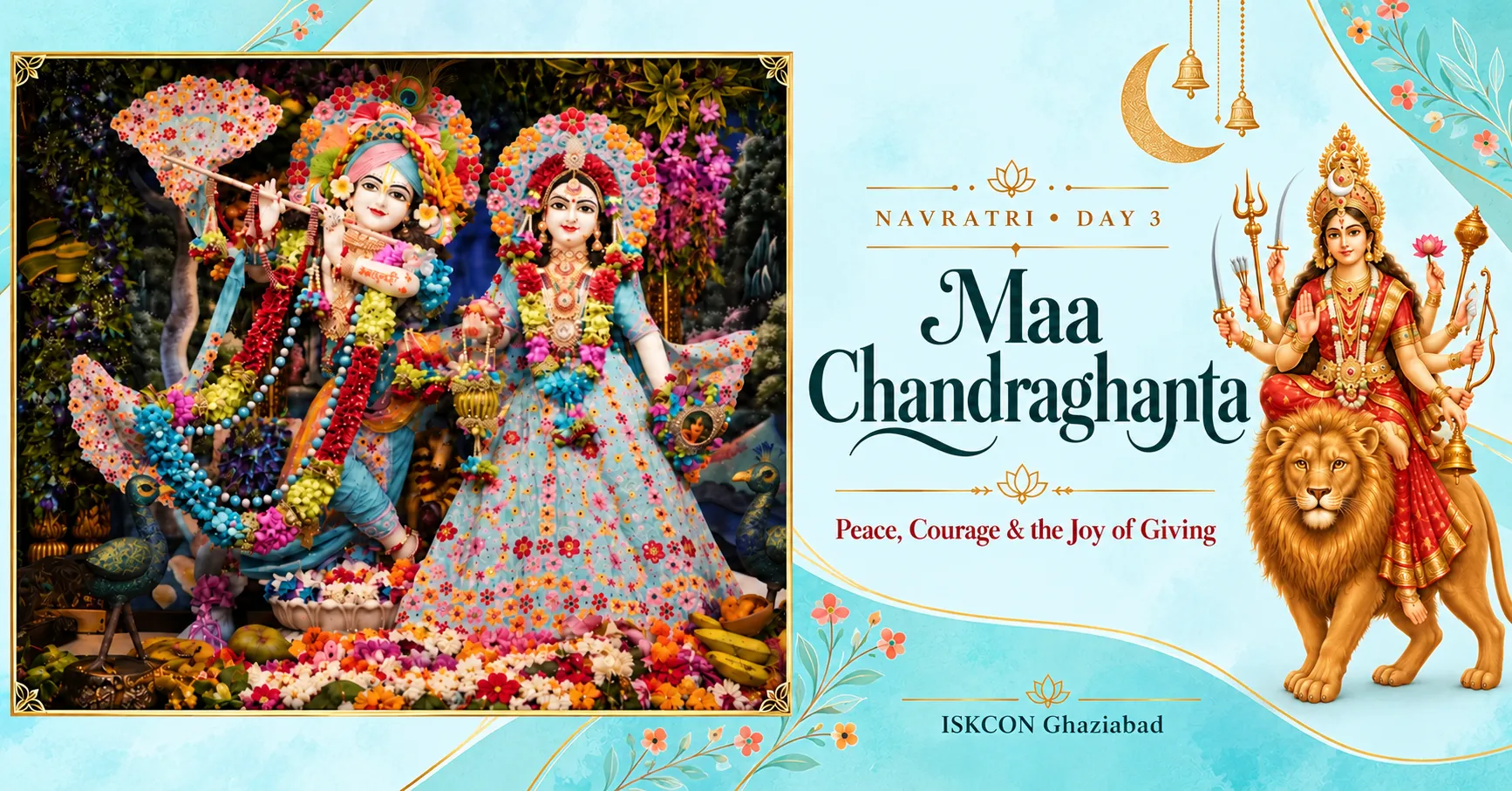
That day, their conversation turns to Maa Chandraghanta, the form of Goddess Durga remembered on Navratri’s third day. The grandfather explains that her name recalls a crescent moon shaped like a bell, and that devotees associate her with courage and peace.
After their prayers, the family steps outside. Nearby, a woman sits with her child. The boy notices that they have no food with them. He looks at the packet his family brought for their own journey home.
“Can we ask if they need something to eat?”
The grandfather pauses. The morning’s reflection has become a practical question. Peace has made room for attentiveness; courage now asks them to respond kindly.
This illustrative story invites us to examine our own festival observance. As we remember Maa Chandraghanta, can our prayers inspire thoughtful service? Through the Bhagavad Gita’s teachings, we can explore a connection between inner steadiness and compassionate action. Supporting annadaan at ISKCON Ghaziabad offers one way to bring that reflection into daily life.
Who Is Maa Chandraghanta?
Maa Chandraghanta is traditionally revered as the third form of Navadurga. Her worship is associated with Navratri’s third day and Tritiya, the third lunar tithi.
Her name combines chandra, meaning moon, and ghanta, meaning bell. It refers to the crescent on her forehead, traditionally described as resembling a bell. Devotional representations commonly show her with multiple arms and a lion or tiger as her mount.
She is remembered for courage, grace, and protective strength. These associations encourage devotees to reflect on the relationship between a peaceful heart and the willingness to face difficulty.
Navratri reflection becomes meaningful when these values influence our behaviour. Remembering Maa Chandraghanta can encourage us to ask whether our strength brings reassurance to others and whether our pursuit of peace includes concern for our neighbours.
The Third Day of Navratri and Its Spiritual Significance
The third day of Navratri gives devotees an opportunity to contemplate Maa Chandraghanta’s qualities and renew their spiritual intentions. Families may observe worship according to their own traditions, while reflecting on the values the occasion brings to mind.
Tritiya means the third lunar day; it is a tithi rather than simply another name for the third night. Navratri is celebrated over nine nights, with devotional observances also taking place during the day.
For many readers, the most useful question is how to carry a festival’s inspiration beyond its rituals. A prayer for peace can lead to gentler speech. A reflection on bravery can encourage responsible action when someone needs help.
At ISKCON Ghaziabad, this article invites that reflection through Krishna conscious service. Hearing the Bhagavad Gita, chanting Krishna’s holy names, and supporting prasadam distribution offer practical ways to cultivate devotion and share care.
The invitation is simple: choose one sincere action that makes the day beneficial for another person, and consider how to continue it after Navratri.
A Bhagavad Gita Perspective on Maa Chandraghanta
The Bhagavad Gita does not directly narrate Maa Chandraghanta’s story or prescribe a separate festival observance for her. The connections in this blog are devotional reflections on related values, rather than claims that Krishna speaks about this Navadurga form by name.
This distinction helps us understand the purpose of the discussion. Maa Chandraghanta’s traditional associations with courage and serenity provide a starting point. The Gita offers guidance on qualities and actions that can shape our lives.
For an ISKCON reader, the centre of spiritual practice is loving service to Lord Krishna. Studying His teachings can help us examine our motives, fulfil responsibilities, and approach others with compassion.
We can therefore ask practical questions. Does our courage help us honour a commitment? Does our calmness make us more attentive? Does our generosity support a useful service?
Peace and Courage Belong Together
In Bhagavad Gita 16.1–3, Krishna includes fearlessness, charity, self-control, tranquillity, compassion, and steady determination among divine qualities. Their presence together provides a helpful foundation for reflection.
In daily life, courage can mean admitting that a problem needs attention. Peace can help us respond without agitation. Compassion directs our attention towards the person affected, while determination helps us follow through.
These are applications of the teaching to ordinary situations. A person who notices hunger nearby might begin by speaking to an organised food-service team. Someone who feels nervous about volunteering can ask for a manageable responsibility.
Remembering Maa Chandraghanta’s courage can inspire this willingness. Let the reflection lead towards a clear commitment: a donation within your means, a task completed carefully, or time offered consistently to a service that needs support.
Inner Steadiness Helps Us Serve Better
Bhagavad Gita 2.48 directs Arjuna to perform his duty with equanimity, relinquishing attachment to success and failure. Its emphasis on steadiness offers a useful perspective for service.
An organised distribution may involve changing circumstances. Supplies can arrive late, schedules may need adjustment, or volunteers may be asked to help with an unfamiliar task. A steady approach supports cooperation.
This application of equanimity should encourage careful effort. It does not remove the need to plan, review mistakes, or improve arrangements. Rather, it can help us remain committed while responding constructively to difficulty.
On Navratri’s third day, consider a simple practice: pause before reacting, listen fully, and carry out the next useful task. Inner steadiness becomes visible through the quality of our actions.
Compassion Begins by Noticing
A crowded festival setting can make it easy to overlook someone who is struggling. We may be occupied with offerings, travel, family arrangements, or our own observances.
Compassion often begins with attention. It asks us to notice whether another person needs help and to respond respectfully. We should avoid assumptions, listen where possible, and remember that a person’s circumstances do not diminish their dignity.
Bhagavad Gita 12.13–14 describes a devotee dear to Krishna as friendly and compassionate towards living beings, alongside other qualities such as self-control and determined devotion. This teaching gives kindness a clear place in spiritual life.
For food seva, kindness influences both planning and conduct. It encourages patient communication, orderly serving, and respect for the people receiving meals. No one should be pressured to offer praise or surrender their privacy to receive help.
Annadaan: Giving Food With Care and Respect
Annadaan means giving food. It meets a basic need and creates an opportunity to share resources with people who may be struggling to obtain a meal.
For a person facing hunger, food can provide immediate relief. For a donor or volunteer, the service is an opportunity to practise generosity with humility. Both the meal and the manner of serving deserve attention.
A responsible approach includes suitable ingredients, clean preparation, safe handling, and coordination. These practical requirements are part of caring for the person who will eat the food.
In a Krishna conscious setting, annadaan can include prasadam distribution. Suitable vegetarian food is offered to Krishna and then shared. The service combines nourishment with devotional intention.
During Navratri, we invite you to consider how your festival spending might include support for food seva. You can give according to your circumstances and ask the temple about its current arrangements. A thoughtful contribution helps turn a wish to serve into something useful.
Why Prasadam Seva Matters in ISKCON
Prasadam holds a special place in ISKCON devotional practice. Food is prepared with care, offered to Lord Krishna, and received with gratitude before being shared with others.
Bhagavad Gita 9.26 teaches that Krishna accepts simple offerings, including a leaf, flower, fruit, or water, when offered with devotion. The verse directs attention towards loving intention rather than material grandeur.
Bhagavad Gita 3.13 discusses accepting the remnants of sacrifice. In Krishna conscious practice, offering food to the Lord and receiving prasadam express this devotional relationship.
Care remains essential throughout the process. A devotional purpose should encourage cleanliness, suitable preparation, and respectful treatment of recipients. The spiritual intention and practical responsibilities belong together.
Supporting prasadam seva allows you to participate in this effort, even when you cannot be present for every stage of the work.
Srila Prabhupada’s Vision for the Temple Neighbourhood
ISKCON’s official food-relief page attributes this instruction to Srila Prabhupada:
“No one within ten miles of an ISKCON temple should go hungry.”
Ten miles is approximately sixteen kilometres. The statement expresses a vision and responsibility for service; it is not a claim that every temple has already eliminated hunger across that distance.
The ideal encourages a temple community to pay attention to the people around it. It asks devotees to consider how food seva can reach neighbours through sustained, organised effort.
For ISKCON Ghaziabad, this vision gives purpose to our appeal for participation. A temple’s ability to organise service depends on resources, cooperation, and the dedication of people willing to help.
Your contribution can become part of that work. By supporting annadaan, discussing current needs with the seva team, or making a continuing commitment, you help bring a compassionate intention into practical activity.
Why Your Part Is Important
Every meal requires a chain of effort. Someone obtains ingredients, someone prepares them, someone cooks, and someone helps serve. Cleaning, transport, and coordination may also be needed.
Donations help support the resources required for this work, according to the temple’s current seva arrangements. Volunteers contribute time and dependable assistance. Organisers bring these contributions together.
Your role matters within that collective effort. A contribution need not be large to be sincere or useful. The appropriate amount is one that fits your circumstances and responsibilities.
Continuing support can also help with planning. If you wish to give regularly, speak with the temple about available arrangements and choose a commitment you can maintain comfortably.
We invite you to give from a wish to serve, without expecting a guaranteed material reward. A donation does not promise wealth, perfect health, or the removal of every difficulty. Its immediate purpose is to help support food seva and the people working to provide it.
What the Gita Teaches About Charity
Bhagavad Gita 17.20 describes charity in goodness as giving from duty, without expecting repayment, at a suitable time and place, and to an appropriate recipient.
This teaching encourages both sincerity and discernment. Before donating, understand the purpose of the service and how to contribute through the organisation’s official arrangements.
You can ask about current needs, sponsorship options, and receipts. Clear communication supports trust and helps ensure that your contribution matches the work being organised.
Giving without expectation also helps us examine our motives. The recipient should not become responsible for satisfying our desire for praise. Service can be offered quietly and respectfully.
Applied to annadaan, the teaching invites a considered contribution towards a responsible food programme. It encourages us to combine a generous heart with practical attention.
How Society Can Help Sustain Food Seva
A community can support annadaan in many ways. Families, working professionals, local businesses, and resident groups can contribute according to their resources and availability.
A family might set aside a portion of its festival budget. Colleagues might make a collective donation. A business owner might ask about supplying suitable ingredients. A resident group might share a verified temple appeal.
Coordination is essential before arranging supplies or volunteers. Confirm what is needed, the quantity, and the appropriate time. An offer becomes more useful when it fits the actual requirements of the service.
Food seva also needs support beyond festivals. A continuing contribution can give Navratri’s values a place in ordinary weeks, when people still need meals and organisers still need resources.
Society’s participation helps spread responsibility. Each person offers what they reasonably can, while the temple team coordinates the work. Through this cooperation, a shared intention can become a dependable practice of service.
Simple Ways to Observe Navratri With Meaningful Service
Begin the day with a devotional intention that you can carry into your actions. You might read a passage of the Bhagavad Gita, chant Krishna’s holy names, or spend a quiet moment considering how to serve responsibly.
Choose one practical commitment. Speak more patiently at home, reduce avoidable food waste, support annadaan, or ask about volunteering. A clear action is easier to maintain than a vague promise.
Families can include children in this reflection. Explain why food should be handled carefully and why recipients deserve respect. Invite them to participate in an age-appropriate way without making another person’s hardship into a spectacle.
Keep the commitment realistic. A modest act completed sincerely has value. If it works well, consider repeating it after Navratri.
The qualities associated with Maa Chandraghanta can inspire the intention; the Gita can guide your reflection; a thoughtful act of seva can give both a place in everyday life.
Frequently Asked Questions About Maa Chandraghanta
Who is worshipped on Navratri’s third day?
Maa Chandraghanta is traditionally worshipped on the third day of Navratri, associated with Tritiya. She is the third form of Navadurga.
What does the name Chandraghanta mean?
Chandra means moon and ghanta means bell. Her name refers to the bell-like crescent traditionally shown on her forehead.
Does the Bhagavad Gita directly describe Maa Chandraghanta?
The Gita does not directly narrate her story. This article connects related values through reflection, especially courage, peace, compassion, devotion, and charity.
Can I support annadaan without sponsoring a large event?
Yes. Ask the temple about current seva arrangements and contribute according to your capacity. Financial support, suitable supplies, or volunteering may be options.
How can I donate at ISKCON Ghaziabad?
Contact the temple through its official channels to confirm current annadaan opportunities and the verified donation method. Ask the seva team about sponsorship details or receipts as needed.
Let Peace Inspire Compassion and Courage Inspire Seva
Think again of the temple bell in our opening story. It helped a child pause and pay attention. Later, that attention opened a conversation about helping someone have a meal.
Navratri can offer us a similar opportunity. Remembering Maa Chandraghanta invites reflection on peace and courage. Studying the Bhagavad Gita helps us examine how those qualities influence our conduct.
At ISKCON Ghaziabad, we invite you to support annadaan and prasadam seva. Society’s cooperation is essential, and your participation is an important part of the effort.
Give according to your capacity. Speak with the temple team about current needs. Consider a commitment that you can maintain beyond the festival.
Support annadaan seva with ISKCON Ghaziabad. Contact the temple through its official channels to donate, discuss a sponsorship, or explore volunteering.
Let your prayer encourage attentiveness. Let your courage help you begin. Let your generosity support the practical work of sharing food with care and dignity.